From Learner to Leader: Latin America’s Emerging Voice in the Global Insights Industry
Article published on Ax Pulse Media
Through Insights Plaza, I regularly speak with senior client-side leaders in consumer insights, analytics, and strategy. Recent conversations with three executives of Latin American origin gave me an opportunity to explore a perspective often absent from global discussions: What happens when a region that has traditionally learned from global centres begins to recognise that it has knowledge of its own to share with the world?
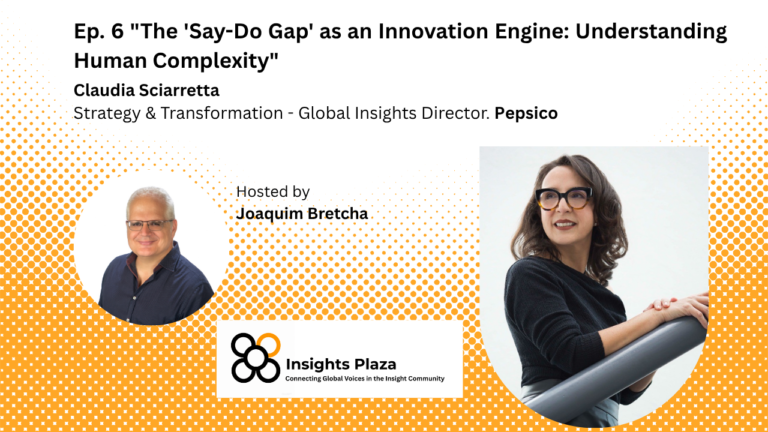
Among the executives I have recently interviewed are Edwin Taborda, a Colombian insights leader currently working for L’Oréal in Asia Pacific after building his career across Latin America and Europe; Claudia Sciarretta, a Mexican executive in a global role at PepsiCo following leadership positions in several multinational organizations; and Juan Carlos Cuadros, a Colombian executive based in Mexico who leads Insights & Analytics across Latin America. Despite their different backgrounds and career journeys, all three share a strikingly similar view: Latin America possesses considerably more professional talent than it often gives itself credit for.
For decades, Latin America’s professional imagination has been shaped by the United States and Europe. Most management theories, business frameworks and research methodologies reached the region through those channels, creating the perception that the most advanced thinking always came from the outside.
One of the most interesting themes emerging from these conversations is that Latin America still suffers from a certain intellectual insecurity. Claudia Sciarretta argues that many Latin Americans assume professionals in Europe or North America are inherently more advanced. Her own experience has led her to the opposite conclusion. She considers the Latin American insights community among the best prepared she has encountered anywhere in the world, precisely because it has learned to operate amid scarce resources, economic instability, political complexity and rapidly changing consumer realities. «Our countries are much more accustomed to curating qualitative and quantitative insights and responding to highly complex economic and cultural situations—far better prepared than people in developed countries, without a doubt. So, I feel that the talent is definitely there.»
Edwin Taborda, after building a career across Latin America, Europe and now Asia, similarly believes the region possesses talent and expertise that deserve far greater global visibility. He argues that more Latin American professionals should seek international careers and greater global influence. «I believe that one of the greatest virtues of Latinos as professionals and as people is the passion they put into what they do; to sum it up, I would point to three things: passion, energy, and optimism—those are the three things that, without a doubt, I see in Latin American talent.»
Juan Carlos Cuadros adds that operating in environments characterized by constant change has made the region’s professionals unusually agile, creative and strategically flexible. «Latin America has nothing to envy other regions. In fact, many times it has an advantage in terms of agility and creativity. We live in more changing contexts, which forces us to be faster and more adaptable.»
Taken together, these perspectives suggest that Latin America’s greatest competitive advantage is not scale or capital. It is resilience and creativity.
Decades of operating with fewer resources and greater uncertainty have forced Latin American professionals to become exceptionally adaptable. The need to generate impact despite limited budgets, incomplete information and constantly changing market conditions has cultivated a combination of creativity, pragmatism and resilience that is increasingly relevant well beyond the region.
I have personally observed this dynamic through my extensive involvement across the region. Over the years, participating in conferences and industry events throughout Latin America, I have repeatedly reached the same conclusion: many of the case studies presented in the region have nothing to envy from those showcased in Europe or the United States.
This capability became particularly visible during the COVID-19 crisis and later during the inflationary wave that followed Russia’s invasion of Ukraine. In several multinational organizations, conversations that traditionally flowed from headquarters to regional offices started moving in the opposite direction, with Latin American teams providing guidance on how to navigate instability and interpret rapidly changing consumer behaviour.
For an Asian audience, however, perhaps the most interesting aspect of these conversations concerns the future.
Despite growing confidence, Latin America remains heavily influenced by intellectual currents coming from the United States and Europe. Asia’s economic influence is undeniable, yet its intellectual influence on many Latin American business communities still has significant room to grow.
According to Edwin Taborda, now based in Singapore, one of the most valuable lessons Latin America can learn today comes from Asia’s approach to innovation and execution. He highlights the ability of countries such as South Korea to identify emerging consumer signals and convert them into market realities at extraordinary speed. More broadly, Asia demonstrates how technology can become naturally embedded in consumers’ daily lives rather than remaining confined to business applications.
Asia’s greatest influence on Latin America’s future may lie not in offering a model to replicate but in demonstrating new approaches to innovation and consumer-centricity. The integration of technology into everyday life across many Asian markets, combined with Japan’s enduring focus on human understanding, offers valuable lessons for the next generation of insights leaders.
The conversations also point toward a broader transformation within the insights profession itself. Access to data is no longer the differentiator it once was. Information is increasingly democratized, and artificial intelligence is accelerating that trend. The future belongs less to the custodians of methodology and more to professionals capable of transforming information into influence, decisions and business impact.
The message emerging from these conversations is not that Latin America should look away from the world, but that it should engage with it differently. Learning from North America and Europe remains essential, yet the next stage of the region’s development will require a broader perspective, one that increasingly includes Asia and is grounded in greater confidence in Latin America’s own capabilities
In an increasingly multipolar world, the future of the insights profession will depend less on where ideas originate and more on how effectively they help transform reality into better business outcomes, better decisions and, ultimately, better lives for consumers. Latin America has more to contribute to that future than it has traditionally believed.