
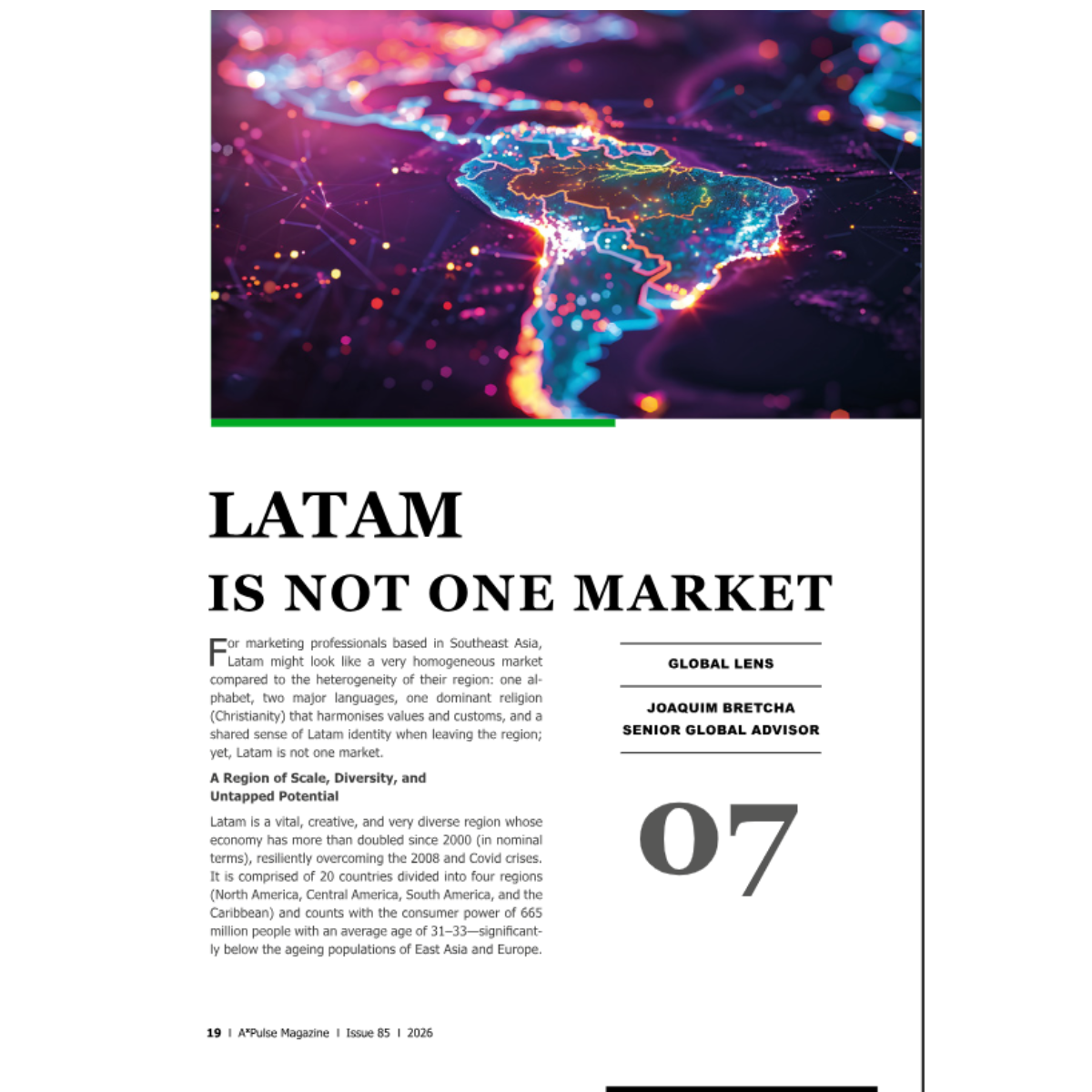
LATAM is not one market
Article published on AxPulse Magazine | Issue 85 | 2026
For marketing professionals based in Southeast Asia, Latam might look like a very homogeneous market compared to the heterogeneity of their region: one alphabet, two major languages, one dominant religion (Christianity) that harmonizes values and customs, and a shared sense of Latam identity when leaving the region; yet, Latam is not one market.
Latam is a vital, creative, and very diverse region whose economy has more than doubled since 2000 (in nominal terms), resiliently overcoming the 2008 and Covid crises. It is comprised of 20 countries divided into four regions (North, Central, South America, and the Caribbean) and counts with the consumer power of 665 million people with an average age of 31-33—significantly below the aging populations of East Asia and Europe. Its demographic diversity ranges from the giants, Brazil (217M) and Mexico (131M), to the smallest and economically sophisticated nations, Uruguay (3.4M) and Panama (4.6M).
Geography, demography, and colonization history have shaped a very diverse societal landscape that benefits from strong commonalities. Let me share with you some common factors that, despite being shared, find their local translation in a reality that is the basis of differentiation.
Latam is the land of dualities where all realities coexist. To truly understand Latam, it is necessary to dive deep into history and understand the initial effect of European colonization on the population. It is estimated that 90% of the native population was decimated before the end of the 17th century. The native population collapse was not homogeneous across the region and today, native population ranges from 41–48% in Bolivia to 25-30% in Peru, down to 1% in Brazil or 0% in Uruguay. Since then, different migration waves of distinct nature—differentiated by countries of destination—have taken place.
In those countries with a strong native and mixed-race presence, colonization had a powerful effect on mentality. People got used to living in two realities: the one perceived by the ruler (governor or Christian authorities) and the natural, real one. The best example of this mindset is described by the 20th-century literary wave called “magic realism,” where reality and unreality coexist. This means, for instance, that even if an outsider speaks proper Spanish, they cannot truly understand the local culture until those insights and communication patterns are well distilled and internalized. By the way, Spanish—the major language—is adopted in its own distinct variety by each country. This implies that regional marketing campaigns must always be adapted locally to resonate with the linguistic nuances of each market.
Latin America has become a highly urbanized region over the past 40 years, with its urban population rising from around 65% in 1980 to over 80% today, placing it among the most urbanized regions in the world. This rapid urbanization has shifted societies with the emergence of their own middle class and the lifting of 80 million people out of extreme poverty since 2000. Societies are massively digitized, being at the top of the world in social media usage and very advanced in native technology habits such as digital payment systems. The big capitals have absorbed the rural population, combining formal and informal economies and forming micro-cities within the big city. And again, Buenos Aires cannot be compared to Mexico City, nor Lima to Santiago de Chile. Each one has followed its own urban model and developed its own economic balances.
Another factor that has determined Latam’s economy is its natural resource richness. Extremely diverse—from minerals to water to agricultural and cattle land—it is a source of country differentiation. This soil richness has promoted an extraction economy culture since colonization, creating the effect known as the «Dutch Disease» and causing inequality. The Gini factor (0 being an equal society, 100 absolute inequality) in Latam is on average 10 points above Southeast Asian countries (45 vs. 35). In marketing terms, the stratification of societies obliges marketers to properly work with segmentation, offering from premium to affordable premium to the newly incorporated middle class, and low cost to the lowest strata.
Political ideologies tend to be prioritized over pragmatism. This strong ideological component in politics causes extreme shifts in policies and economic strategies when governments change. This can create legal uncertainty and economic variability. Again, this is not homogeneous across countries. Furthermore, political and economic alliances in the region are weak due to divergent national interests, emphasizing the ‘border effect.’ A notable exception is Mercosur, the long-standing economic alliance of the Southern Cone, which remains the primary integration effort in South America. Brazil and Mexico are giant economies that can play a self-sufficient role rather than delegating to a supranational organization. This economic nationalism has fostered the establishment of big national brands that, on many occasions, benefit from a larger market share than foreign multinationals. An interesting phenomenon is the creation of regional brands («Multilatinas») that serve the whole region, leaving little room for multinationals.
Latam looks to the United States for business, technology, and entertainment; to Europe for values, urban life, social rights, and regulation; and in the last decade, China has emerged as the silent, big commercial partner in the region, particularly for countries like Brazil, Chile, or Peru.
Finally, to summarize relevant distinctions, we have selected the most representative countries to conclude that:
- Brazil: A continental powerhouse with a highly sophisticated tech-driven economy and vast internal market, currently focused on bridging its significant social disparities.
- Mexico: A strategic global industrial hub leveraged by its proximity to the US, characterized by a dynamic industrial North and a culturally rich, traditionally agricultural South.
- Colombia: A resilient economy with a purchasing power equivalent to Thailand’s, showing solid historical growth and a strong concentration of innovation in key hubs like Bogota and Medellin.
- Argentina: Historically the region’s most egalitarian society with high-caliber human capital and a strong European cultural profile, currently navigating institutional and economic volatility.
- Chile: The region’s benchmark for institutional stability and open-market policies, while actively working on addressing its structural population inequality.
- Peru: A consistently growing economy driven by mineral exports and a burgeoning service-oriented middle class that is transforming the local consumer landscape.
Compared to Asia, Latin America benefits from many structural commonalities. However, diversity is the norm—in each country and throughout the region. The profound need to understand the Latin American population in all its diversity has propelled a very healthy, innovative, agile, and ingenious market research community. This is a community that has learned to embrace the latest methodologies while bringing an unparalleled capacity to navigate the unexpected—whether it be inflation, political shifts, or the logistics of an informal economy. It is a community that other regions can learn from, and I invite you to do so