Argentina’s World Cup: When Belief Becomes a National Conversation
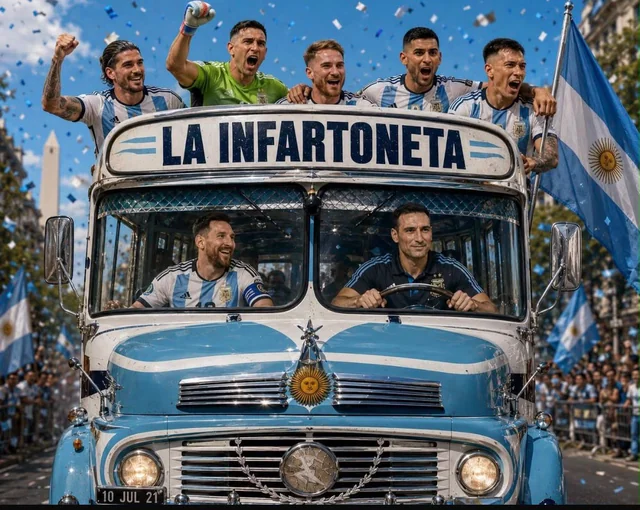
Some World Cup stories are written on the pitch. Others are written in the emotions of the people watching.
When we started analysing Argentina’s social media conversations during the knockout stages of the World Cup, I expected to find discussions about football: players, tactics, referees and results. Instead, what emerged was something much more interesting. We found a collective emotional journey in which hope, superstition, anxiety, humour and belief constantly interacted with one another. The result was not simply a football story. It was a cultural story.
Together with the UK based Social Media agency Listening247, the Argentinian trends’ agency Trendsity, the Mexican strategic research consultancy Altazor and the Peruvian market research consultancy Datum Internacional, we analysed more than 104,000 social media conversations generated on X, TikTok and Instagram from the Round of 32 onwards. What the data revealed is that Argentina’s path to the latter stages of the tournament was not a steady rise in confidence. It was a roller coaster where supporters repeatedly moved between certainty and panic, only to return, once again, to belief.
Arriving Full of Confidence
To understand the emotional journey, it is important to remember where Argentina stood before the knockout rounds began.
Argentina had comfortably come through the Group Stage, defeating Algeria, Austria and Jordan without major incidents. Expectations were high. By the time they faced Cabo Verde in the Round of 32, supporters were already discussing deep tournament runs and another possible World Cup title.
Yet, even at the height of optimism, a fascinating cultural phenomenon appeared over and over again in social media conversations: anulo mufa. Literally translated as «I cancel the jinx», anulo mufa has become one of the most distinctive expressions in contemporary Argentinian football culture. Whenever confidence starts to feel excessive, somebody writes those two words, almost as an emotional insurance policy against bad luck. It is superstition, humour and collective wisdom all at once.
For an outsider, it may seem like a simple internet meme. For Argentinians, it reflects something much deeper: confidence is welcome, but never trusted completely.
Cabo Verde: The Beginning of the Roller Coaster
The match against Cabo Verde marked the beginning of the emotional roller coaster.
Argentina advanced, but not in the dominant fashion many supporters had expected. Victory generated joy and celebration immediately afterwards, but the following days saw positive sentiment decline significantly. This pattern is remarkably revealing. The result itself was not enough. Expectations had been so high that qualification alone did not completely satisfy supporters. What mattered was how the team had achieved it.
The first seeds of uncertainty had been planted. What nobody knew at the time was that uncertainty would soon become one of the defining characteristics of Argentina’s tournament.
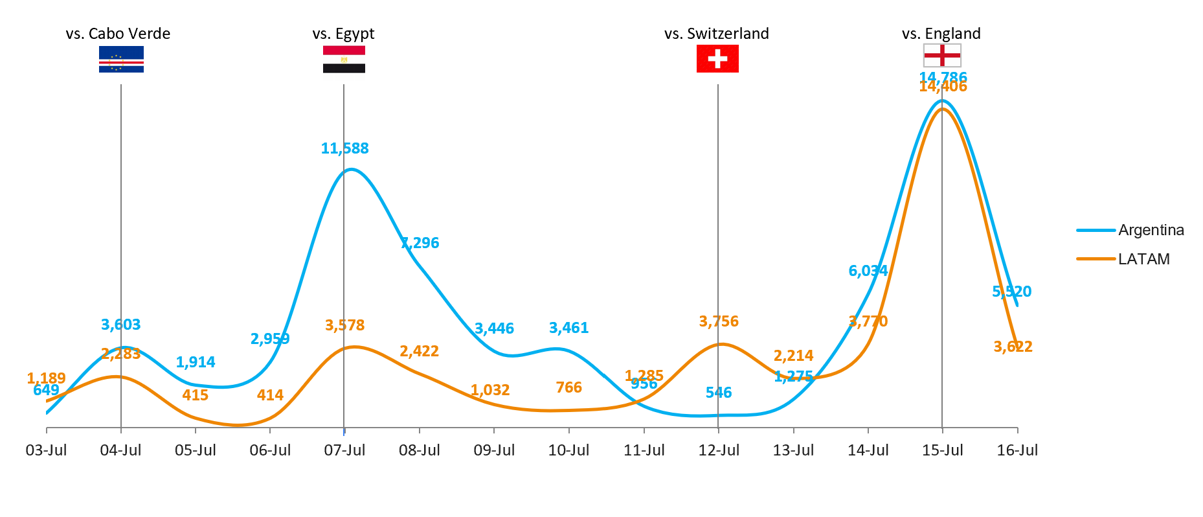
Number of Posts on X, Instagram and TikTok
Egypt and the Creation of New Cultural Codes
If one match touched a nerve across Argentina, it was Egypt.
The volume of online conversations exploded. The match generated one of the highest activity peaks of the entire analysed period, second only to the semifinal against England. The emotional reaction went far beyond football.
The reason is easy to understand. Argentina suffered. A lot. But suffering often creates culture, and nowhere was this more visible than in the emergence of two expressions that quickly became part of the tournament’s vocabulary: infartoneta and minuto 79.
The first combines infarto (heart attack) with Scaloneta, the nickname of Scaloni’s national team. The result is a term capable of describing exactly how millions of supporters experienced every dramatic moment of the knockout rounds. The second, minuto 79, became a symbolic reference to the moment hope returned when it seemed all but lost. It evolved beyond a simple football reference and became shorthand for those moments when people feel they are on the verge of collapse but somehow continue believing.
For researchers, these expressions are fascinating. They demonstrate how communities create language in real time to make sense of shared emotional experiences.
This Became Messi’s World Cup
Throughout the entire period analysed, Messi remained the central topic of conversation. Without a doubt, this has become Messi’s World Cup.
Every major discussion eventually returned to him: his performances, his leadership, his milestones and the possibility of witnessing yet another extraordinary chapter in a unique career. Whether conversations were positive, anxious, hopeful or celebratory, Messi sat at the centre of the narrative.
What was perhaps more surprising was the evolution of Lionel Scaloni’s presence in the conversation. His visibility increased significantly on match days, particularly as Argentina continued progressing through increasingly dramatic encounters. Supporters discussed his tactical decisions, substitutions and ability to make adjustments under pressure.
Then something remarkable happened. Following the victory against Switzerland and qualification for the semifinal against England, Scaloni briefly overtook Messi as the most mentioned individual in Argentina. That finding deserves attention. It suggests that supporters were no longer talking only about the team’s greatest player. They were increasingly recognising the role of the coach in navigating constant adversity. Scaloni had stopped being a background figure and had become one of the central protagonists of the story.
Outside Argentina, however, the situation was different. Across Latin America, Messi remained, by a very wide margin, the dominant figure. Scaloni was respected, but the fascination generated by Messi operated on a completely different scale.
Egypt and the Emergence of the Favouritism Debate
The victory against Egypt created a second conversation which did not start inside Argentina. It started outside.
Following the dramatic comeback, a growing number of commentators and supporters across Latin America began questioning refereeing decisions, VAR interventions and FIFA’s alleged desire to see Messi lift another World Cup trophy. Narratives such as VARgentina, FIFA favouritism and various conspiracy theories quickly gained traction across the region.
What is interesting is not so much the existence of these narratives, but the reaction they triggered inside Argentina. Argentinian supporters rapidly engaged in the discussion, not because they doubted their team, but because they felt compelled to defend it. Many conversations involving FIFA, refereeing and VAR were actually responses to criticisms originating elsewhere.
The debate therefore became less about referees and more about identity. Supporters felt they had to defend the legitimacy of their team’s achievements. The conversation was not one of self-doubt. It was one of collective defence.
Embracing Tension
The most powerful insight emerged after Switzerland.
By that point, Argentina had already survived multiple dramatic scenarios. The football had not necessarily become easier. The stress had not disappeared. The uncertainty remained. Yet something fundamental had changed. Supporters no longer seemed surprised by suffering.
They had accepted it. The final minutes of matches stopped being perceived solely as a source of anxiety and increasingly became the stage where Argentina’s resilience would reveal itself once again. The data suggests that supporters were no longer asking whether the team could survive difficult moments. They had already convinced themselves that it would.
This transformation is perhaps the most important finding of the entire study. Argentina’s supporters had embraced tension as part of the journey itself. The roller coaster was no longer an obstacle to overcome. It had become part of the experience they expected and, in some ways, even celebrated.
The England Effect
All these trends converged in the semifinal against England.
The match generated the highest volume of social media activity of the entire analysed period. Conversations exploded before kick-off, intensified throughout the game and continued long after the final whistle. By then, belief had reached extraordinary levels.
Inside Argentina, confidence in Messi, Scaloni and the team’s ability to overcome adversity reached its highest point of the tournament. Across the rest of Latin America, discussions about Messi, Argentina’s mystique and the possibility of repeating as world champions also reached their strongest levels.
Interestingly, while some negative narratives remained present, positive themes dominated the conversation. Messi, Argentina’s mystique, Scaloni’s leadership, the possibility of becoming champions again and, naturally, humour and memes occupied centre stage.
Supporters and detractors remained locked in debate, but one thing became increasingly clear: Argentina had become the central story of the tournament.
More Than Football
Looking back at the data, what stands out most is not the controversy, the refereeing discussions or even the results themselves. It is the persistence of belief.
Confidence rose and fell. Anxiety appeared and disappeared. New expressions such as anulo mufa, infartoneta and minuto 79 emerged to explain the emotional journey. Yet beneath every discussion ran the same thread.
Argentina never stopped believing. And perhaps that is the real story hidden in the data. This was not simply a World Cup campaign. It was a collective exercise in belief.
And now comes the ultimate question: can belief overcome excellence?
Will it be enough to overcome Spain, a formidable side that has conceded just one goal throughout the tournament and famously dismantled France, one of the pre-tournament favourites?.
Soon, we will discover which force is stronger. Fasten your seatbelts. This promises to be one unforgettable final.