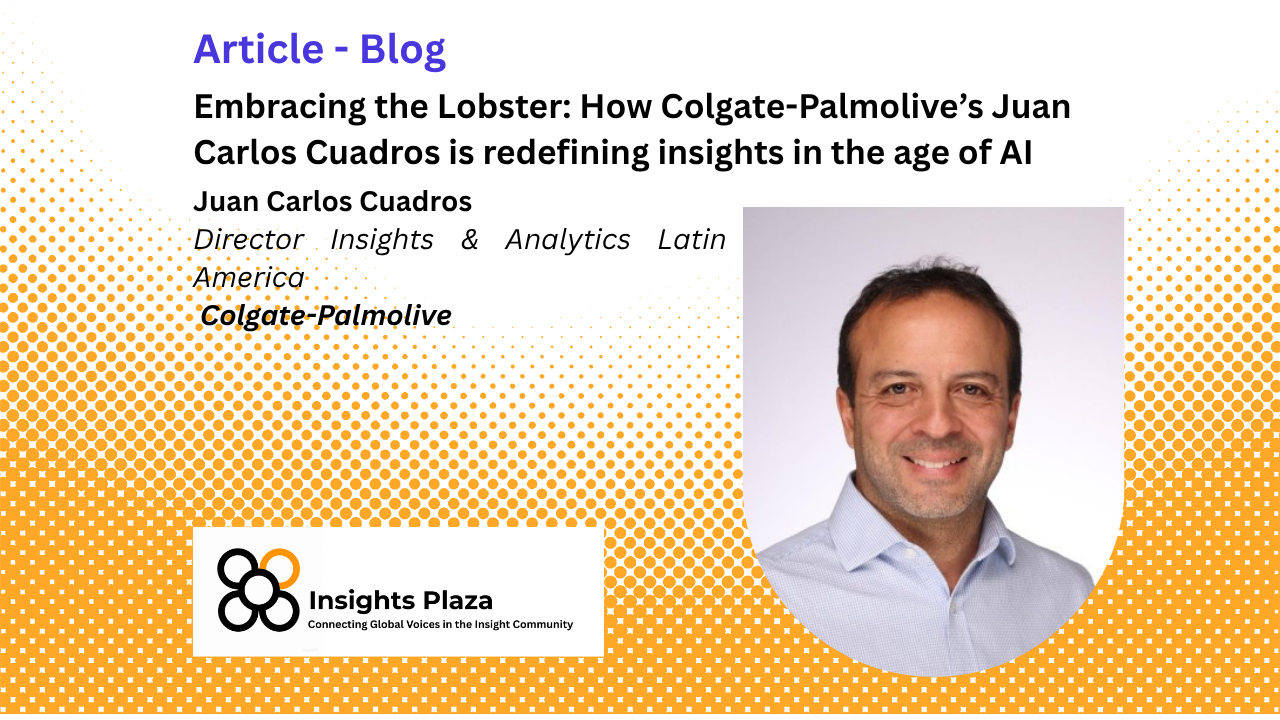
Embracing the Lobster: How Colgate-Palmolive’s Juan Carlos Cuadros is Redefining Insights in the Age of AI
In the fast-evolving landscape of global markets, the role of data and insights is undergoing a radical transformation. To explore this shift, the latest episode of Inside Plaza brought together Joaquín and Juan Carlos Cuadros, Director of Insights & Analytics for Latin America at Colgate-Palmolive. With over two decades of experience leading strategy for global giants like Diageo and co-founding his own planning agency, Cuadros shared a masterclass on career growth, corporate agility, and how artificial intelligence is reshaping multinational operations.
Here are the key takeaways from a conversation that serves as a blueprint for the future of business strategy.
1. The Lobster Metaphor: Growth Requires Discomfort
Cuadros grounds his leadership philosophy in a powerful metaphor by Rabbi Abraham Twerski: the lobster. A lobster is a soft animal living inside a rigid shell. As it grows, the shell becomes uncomfortably tight. To survive and expand, the lobster must hide, cast off its old shell, and produce a new one—a process repeated throughout its life.
«The stimulus for growth is discomfort,» Cuadros explains. From leaving the safety net of corporate life to entrepreneurship, and later bringing that agile, startup mentality back into a multinational setting, he views discomfort not as a hurdle, but as a mandatory signal to evolve.
2. The AI Revolution at Colgate-Palmolive: Driving In-Sourcing and Strategy
Moving past the hype of big data and the metaverse, the conversation dove deep into the practical application of Artificial Intelligence. At Colgate-Palmolive, AI is not about replacing human talent; it is about giving them «superpowers.»
The most tangible impact has been a massive shift toward in-sourcing. Processes like meta-analyses, which historically took weeks and required external vendors, are now being executed internally in a matter of minutes through advanced platforms. By automating heavy operational data cleaning, the team has shifted its core focus from mechanical processing to high-level strategic thinking and mastering the art of prompting.
3. Bridging the ‘Say-Do Gap’ with Hybrid Methodologies
One of the oldest challenges in market research is the say-do gap—the disparity between what consumers claim they do and how they actually behave. «If you ask people if they brush their teeth three times a day, almost everyone says yes,» Cuadros notes.
To capture reality, Cuadros advocates for a hybrid approach. Rather than discarding traditional methodologies, the goal is to enhance them by blending consumer declarations with passive measurement, behavioral data, and emerging technologies like digital twins. However, tech has its limits. The ultimate differentiator remains uniquely human: empathy and the cultural intuition required to understand the emotional context behind the data.
4. Latam Insights Professionals are highly competitive
¨We need to believe in ourselves more.’ Juan Carlos notes that the extreme adaptability and creativity of Latam professionals make them highly competitive globally. Furthermore, a deep cultural understanding of both the commonalities and the distinct differences across this massive region is absolutely key to succeeding.
5. Earning a Seat at the Table
For insights professionals looking to influence C-suite decisions, Cuadros delivers a blunt truth: «A seat at the table isn’t requested; it’s earned.»
If practitioners act merely as data vendors, they will always be viewed as a cost center. To become indispensable strategic partners, they must master the commercial language of the business, have the courage to challenge executive decisions, and directly translate complex data into measurable business growth, sales, and distribution.
6. Designing the Future: The Consultant-Style Department
Looking ahead, Cuadros outlines a high-caliber vision for the ideal insights department, structuring it less like a traditional corporate unit and more like an agile internal consultancy.
This modern department relies on a dual engine: a powerful AI infrastructure that handles the operational and mechanical workload, paired with a team of sharp strategists. His advice to the next generation of professionals is simple: don’t compete with machines on what they do best. Instead, sharpen your critical thinking, perfect your questions, develop deep empathy, and «hit the streets» to observe real-world human behavior firsthand.