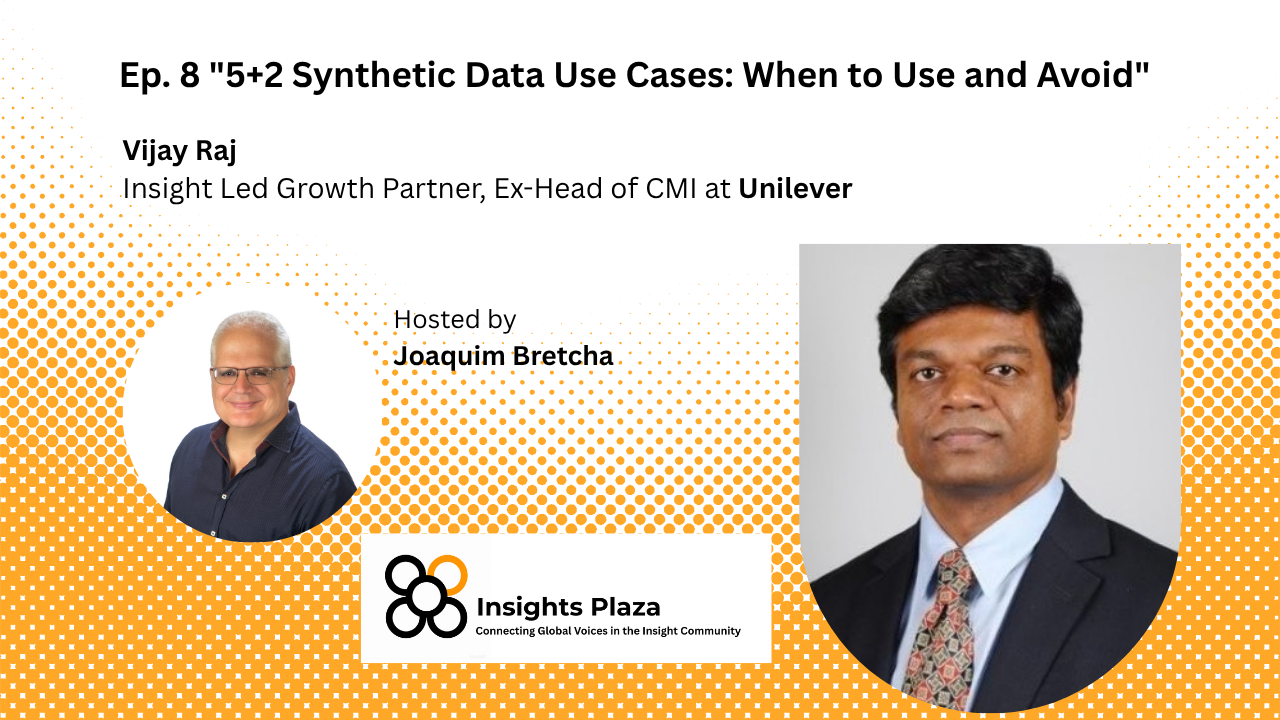
«5+2 Synthetic Data Use Cases: When to Use and Avoid» – Vijay Raj
«Technology is a means to an end. Understanding people is the goal. Insights are the bridge. Growth is the outcome.»
What does the future of the insights profession look like in an era dominated by AI, synthetic data, and intelligent agents?
In this episode of Insights Plaza, I speak with Vijay Raj, former Global Head of Consumer & Market Insights at Unilever, whose career spans more than 25 years across India, Indonesia, Singapore, the UK, and global leadership roles. Vijay shares a thoughtful perspective on how the profession is evolving, why understanding people remains the industry’s core mission, and how insights leaders can navigate the opportunities and risks created by AI-driven innovation. Drawing on decades of experience, he offers practical guidance for clients, agencies, technology providers, and the next generation of insights professionals.
Key Takeaways
• The fundamentals of insights have not changed. The mission remains helping businesses make better decisions through a deeper understanding of people, even as technologies and methodologies continue to evolve.
• «Outsights» are still essential. Data and reports are necessary, but real empathy comes from spending time with consumers, observing behaviours, and experiencing the realities of people’s lives firsthand.
• AI should reinvent workflows, not simply automate existing ones. Vijay believes the biggest opportunity lies in designing entirely new AI-native tools and decision-making processes rather than adding AI to traditional approaches.
• A new discipline is emerging: Algorithm Insights. Just as the industry evolved from consumer insights to shopper insights, professionals now need to understand how algorithms influence discovery, choice, and consumption.
• Technology will increase the value of human understanding, not replace it. As automation expands, cultural understanding, ethnography, semiotics, and foundational qualitative research become even more important.
• AI-moderated qualitative research has a role, but not everywhere. It can efficiently explore reactions to stimuli and some sensitive topics, yet it is not a substitute for deep strategic understanding or skilled qualitative researchers.
• Synthetic data is a powerful accelerator, not a universal solution. It can reduce costs and speed up learning, but only when built on relevant, robust, and recent training data and applied to the right business questions.
• The best current uses of synthetic data include hypothesis generation, concept refinement, stimulus screening, sample augmentation, and cost-effective brand tracking.
• Synthetic data should be used cautiously for high-risk decisions. Vijay specifically warns against relying on it for pricing decisions or foundational consumer understanding such as segmentation and attitudes studies.
• The future insights function will become a decision engine. Always-on systems, data lakes, and intelligent agents will increasingly help organisations move from reporting insights to enabling decisions.
• The Say-Do Gap cannot be solved through a single methodology. The answer lies in combining multiple data sources and identifying contradictions between what people say and what they actually do.
• Client-side teams should treat agencies as strategic partners, not vendors. Doing so creates a force multiplier that significantly extends the impact of internal insights teams.
• Agencies must move beyond methodological rigour and focus on action. The most valuable partners help clients move from «What?» to «So what?» and ultimately to «Now what?».
• Great insights leaders are focused on people growth as much as business growth. Reflecting on his Unilever career, Vijay identifies developing talent and helping people reach their potential as his proudest achievement.
• The most important skill for future professionals is the ability to learn, unlearn, and relearn. Technologies will change continuously, but adaptability will remain the defining capability for long-term success.